
With the majority of the property being forested, there are plenty of management opportunities which can be implemented to improve forest health and diversity, while reducing susceptibility to pests, diseases, and the expansion of undesirable nonnative invasive species. The Sanctuary’s interest to enhance habitat to support high quality hunting and wildlife viewing opportunities prompts an aggressive forest management approach centered on vegetation and brush management and invasive species control. Management recommendations for habitat enhancement focus on two primary objectives:
- Improve wildlife habitat by increasing the carrying capacity of the forest and
- Promote forest health
Management Goals and Objectives
Defining management goals, both short term and long term, is the primary step in developing an effective management plan. The following goals were identified by representatives of Lacawac Sanctuary:
Deer Management and Hunting
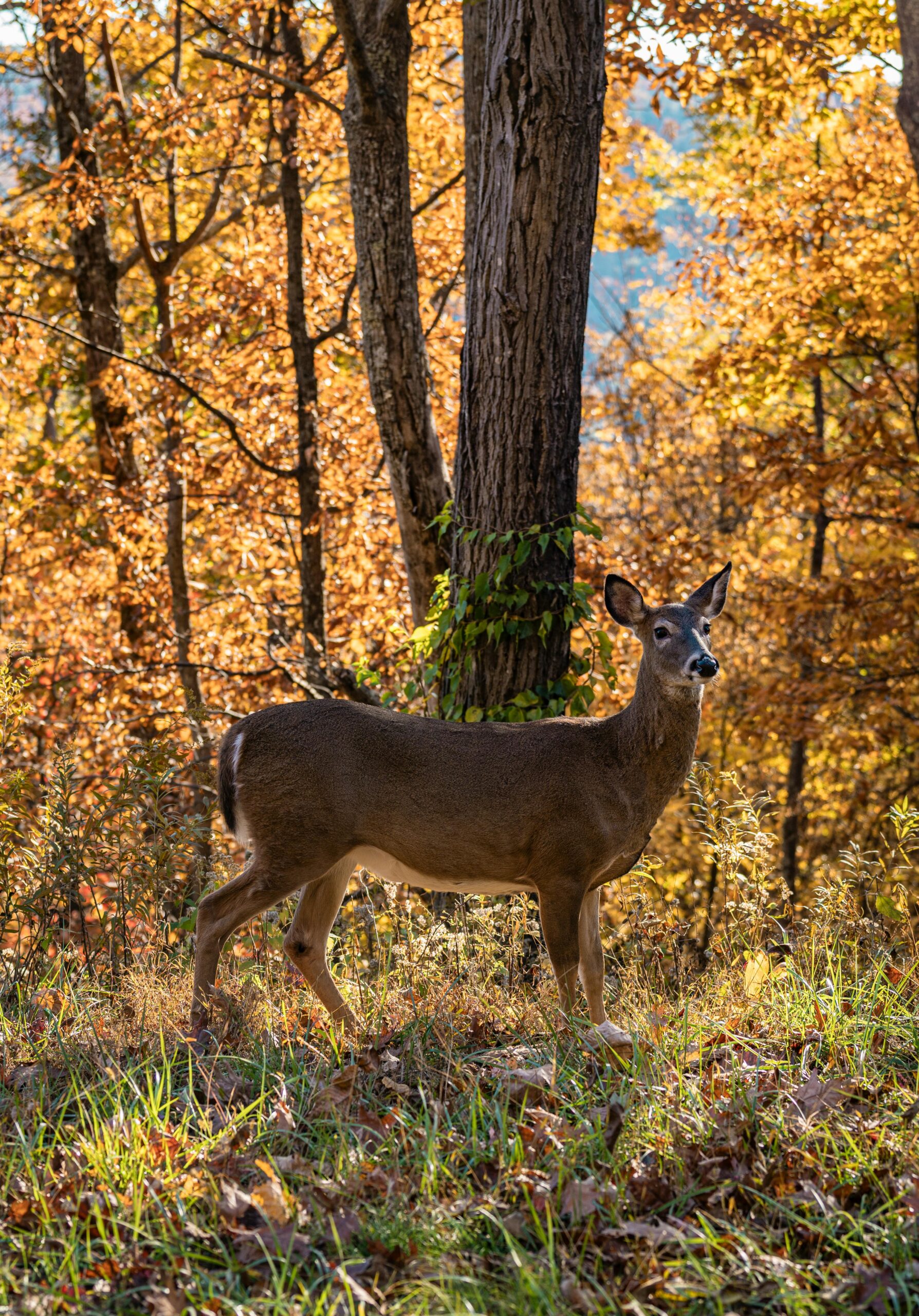
Over the past century, white-tailed deer populations in Pennsylvania rose dramatically from less than 2-3 deer/m² in 1900 (estimated) to an estimated average of 10-15 deer/ m² for much of the 20th century. The dramatic increase in deer numbers correlates to the reforestation of Pennsylvania’s landscape following near-complete deforestation by the 1930s. Low deer populations allowed seedling and sapling growth over millions of acres, which in turn set the table for a population explosion of white-tailed deer. In addition to abundant sources of food, other factors including the lack of natural predators and a hunting tradition focused on buck harvesting, lead to overabundant populations.
The lack of natural predators allowed deer populations to reach beyond carrying capacity (i.e. the size of a population that can be supported in an area without degrading the habitat.) throughout Pennsylvania. Overabundant deer populations deplete the structure and diversity of the understory seedling/shrub layer and prevent acceptable forest recovery from any disturbance within forest communities. Once preferred plant and woody stem species are consumed, deer will then move on to secondary species that they like less, but can tolerate.
If deer densities increase beyond the carrying capacity of a specific habitat, the results of over-browsing can negatively impact forest health and diversity. Given the complex dynamics associated with ecological systems, the impact of overpopulation and over-browsing is exhibited in many ways including:
- Reduced tree regeneration
- Increased fern cover
- Reduced breeding songbird diversity
- Facilitated exotic plant invasions
- Reduced rare species abundance
- Altered species diversity
- Decreased plant size and fecundity
- Increased Lyme disease risk
Current conditions on the Sanctuary property reflect the impact of abundant deer populations. Research suggest the carrying capacity of healthy white-tailed deer populations in eastern forests is between 10-15 deer per square mile. This proposes the Sanctuary property, under healthy forest conditions, could support roughly 8-11 deer within its boundary.While dense conifer shade has limited understory species retention in some areas, years of intensive browsing have generally depleted the forest understory of wildflowers, woody shrubs, and competitive seedlings and saplings. Less palatable species including non-native invasive plants (Japanese barberry and stilt-grass) and native invasive species (hay-scented fern), have displaced desired vegetation in new growing sites. The lack of competitive seedlings and saplings, as well as forbs and shrubs, not only degrades forest health but lessens habitat quality and ability to support healthy deer populations.